Bitcoin Falls Below $82K as Hot CPI Revives Fed Rate Hike Bets

- Hotter U.S. inflation raises the prospect of another October Fed hike.
- Altcoins suffer deeper losses as investors reduce risk exposure.
- Rising derivatives open interest adds uncertainty to the selloff.
Bitcoin fell below $82,000 on Wednesday after stronger-than-expected U.S. inflation revived expectations of another Federal Reserve interest rate increase, putting renewed pressure on cryptocurrency markets.
September’s Consumer Price Index (CPI) rose 3.7% from a year earlier, exceeding the 3.6% consensus forecast and accelerating from 3.4% in August. The report pushed Treasury yields higher and prompted traders to increase their bets on tighter monetary policy.
The cryptocurrency market lost approximately 2.28% of its value over 24 hours, bringing total capitalization to $2.74 trillion, according to a CoinMarketCap.
Bitcoin’s decline was relatively contained compared with losses across several major altcoins. That divergence suggests investors were already becoming more selective about risk, with the inflation surprise adding pressure to a market that had weakened over the preceding week.
The CPI Surprise Was Not Just About Gasoline
The Bureau of Labor Statistics reported a 0.6% monthly increase in consumer prices, up from 0.4% in August.
Gasoline was responsible for more than half of September’s headline increase, with prices rising 9.1% during the month. The broader energy index climbed 5.2%, reflecting a sharp rise in fuel costs.
That concentration matters. Energy prices can respond quickly to supply disruptions, producing large movements in headline inflation without equivalent increases across other categories.
But the underlying figures also exceeded expectations.
Core CPI, which excludes food and energy, increased 2.6% annually, compared with 2.4% in August. Its monthly increase remained at 0.3%, indicating that underlying price pressures persisted even as the headline figure accelerated.
Shelter costs rose 0.4%, while food prices were unchanged.
For the Federal Reserve, the difficulty lies in separating the immediate energy shock from more persistent inflation. A sharp increase in gasoline prices may eventually reverse, but continued increases in shelter and other services make an early return to the 2% inflation target less certain.
Rate Markets Reprice the Fed’s Next Decision
The inflation release produced a measurable shift in monetary policy expectations.
According to the Financial Times, traders raised the implied probability of an October interest rate increase to approximately 45%, compared with 22% before the report.
The change followed the Fed’s September rate increase and came less than two weeks before its October 27–28 policy meeting.
Higher Treasury yields create competition for risk assets. Investors can earn greater returns from government securities while borrowing costs rise for leveraged market participants.
For Bitcoin, the pressure is particularly relevant when traders have positioned for more accommodative monetary conditions.
A higher expected policy rate can encourage investors to reduce leveraged positions or move capital into interest-bearing assets. Cryptocurrency markets are also vulnerable to rapid adjustments because they trade continuously, including when traditional financial markets are closed.
The CPI release does not determine the Fed’s decision on its own. But the immediate repricing shows that investors now see a greater risk of further tightening than they did before Wednesday’s data.
Altcoin Weakness Reveals a Broader Risk Retreat
The latest market data showed Ethereum, Solana, XRP and Dogecoin all declining more sharply than Bitcoin over the previous 24 hours.
The difference becomes more pronounced when examining weekly performance.
Solana had fallen 10.46% over seven days, compared with Bitcoin’s 1.31% decline.
The spread is useful because it shows that weakness was not limited to the immediate reaction to the inflation report.
Investors had already been assigning substantially different valuations to risk across the cryptocurrency market.
Higher-volatility assets often experience larger price swings during periods of macroeconomic uncertainty, particularly when traders reduce exposure to speculative positions.
The latest decline reinforces that pattern, although the relative performance alone cannot establish whether selling came primarily from institutional investors, retail traders or leveraged accounts.
The Crypto Fear & Greed Index stood at 51, indicating neutral sentiment despite the broad retreat.
That reading suggests the market had weakened without entering the extreme fear conditions sometimes seen during larger liquidation events.
Derivatives Positioning Complicates the Selloff
Aggregate cryptocurrency derivatives open interest reached approximately $395.83 billion in the supplied market dashboard, an increase of 1.56%.
The figure is notable because outstanding derivatives exposure increased while spot prices declined.
One interpretation is that traders continued opening positions during the selloff rather than broadly exiting the market. However, open interest includes both long and short exposure, making it impossible to identify the dominant direction from the aggregate figure alone.
The combination still matters for volatility.
If prices continue falling while leveraged long positions remain elevated, forced liquidations could accelerate the decline. Conversely, a rapid recovery could pressure newly established short positions.
Trading volume provides additional context. The dashboard showed approximately $799.03 billion in 24-hour derivatives volume, down 12.69%.
The figures describe a market where outstanding contracts increased despite lower turnover, leaving positioning an important factor in the next price movement.
They do not, by themselves, demonstrate an imminent liquidation cascade.
Bitcoin’s Daily Chart Shows Fading Momentum
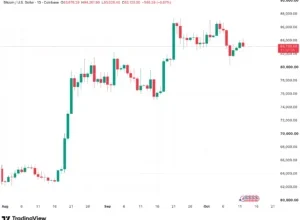
Bitcoin’s daily TradingView chart, captured on October 14, showed the cryptocurrency trading near $81,821.

The pullback follows a rally that briefly carried Bitcoin above $86,000 earlier in October. Recent daily candles show that the cryptocurrency has struggled to maintain those gains, with prices retreating toward levels traded before the latest advance.
Momentum indicators also point to a weaker short-term picture.
The 14-day Relative Strength Index (RSI) stood at 47.40, below its displayed moving average of 56.40. The RSI has also slipped beneath the neutral 50 threshold, indicating that upward momentum has weakened.
However, the indicator remains above 30, meaning Bitcoin has not entered conventionally oversold territory.
The chart therefore shows a market losing momentum after its recent rally, rather than providing confirmation of a new downward trend. The next daily closes will help establish whether selling pressure persists or buyers begin to regain control.