Starknet Moves Toward Leaving Ethereum as STRK Slides 41%

- Starknet holders approved research into turning the network into an independent, post-quantum Layer 1.
- The vote was non-binding and does not commit Starknet to leaving Ethereum.
- Foundation-delegated STRK supplied most of the voting power.
- STRK has erased most of its October rally and trades inside a descending channel.
Starknet’s non-binding governance poll on researching a move from Ethereum Layer 2 to an independent, quantum-resistant Layer 1 closed on October 22 with 93.52% of voting power in favor. More than 2,800 wallets voted over seven days on Snapshot. The outcome authorizes study, not migration, and StarkWare plans to publish a draft whitepaper in November 2026. STRK did not rally on the news. The token fell 11.7% in 24 hours and 41% over the week, according to CoinMarketCap, and trades near $0.0545 with a market value of about $414 million.
Snapshot poll ends at 93.52% for research, not for an exit
Voters had three choices: back more research, reject the idea, or stay neutral until more details emerge. The 93.52% figure measures voting power, which scales with the STRK behind each address, so it says little about how many individual holders agreed. Early tallies above 99.9% circulated widely before the final count. The final count showed about 489 million STRK in voting power across 3,236 votes, with 4.6% choosing No and 1.9% asking for more information. According to the poll on Starknet’s Snapshot space, a Yes result triggers research and further proposals, so any real transition still needs separate governance votes.
The Starknet community has voted to research whether Starknet should become an independent, post-quantum L1.
Starting today, a joint @StarkWareLtd × @StarknetFndn working group will lead the research and publish a paper in the coming months. pic.twitter.com/26jV9IXKLv
— Starknet (@Starknet) October 22, 2026
StarkWare’s 2027 target collides with Ethereum’s December 2029 deadline
Starknet works as a validity rollup. It executes transactions off Ethereum’s main chain and posts a cryptographic proof to Ethereum showing each batch was processed correctly. Ethereum handles settlement, and Starknet’s bridge and data availability depend on it. Most blockchains authorize transactions with elliptic-curve signatures, which a large enough quantum computer could in theory break, and post-quantum signature standards exist precisely to replace them. Starknet’s STARK proofs rely on hash functions, which are considered more resistant to known quantum attacks. The Ethereum-linked components still upgrade only as fast as Ethereum does.
StarkWare CEO Eli Ben-Sasson first raised the L1 idea on October 8, and two days later StarkWare called an independent L1 its clearest path forward, so the poll asked holders to endorse a direction the team had already chosen. The Ethereum Foundation’s Protocol cluster aims for quantum resistance across execution, consensus and data by December 2029, while the Ethereum quantum-resistance roadmap treats that year as a planning target. After the vote, Ben-Sasson told The Block that Ethereum’s 2029 target is too late and that deadlines slip, pointing to the long wait for the Merge.
41 addresses carried 94% of the voting weight
Analyst Illia Cherviakov reviewed 2,593 votes recorded by October 19 and found that Foundation-delegated STRK supplied 94.1% of the 375.7 million voting power, spread across 41 addresses.
Who supplied the voting power
375.7M STRK across 2,593 votes, as of October 19
Delegation is not direct voting. Under Starknet’s model, the Foundation delegates voting power and does not vote directly. Cherviakov also found that independently held voting power backed the proposal by about 99.3%, so the result likely stands without the delegated stake. The weak link is turnout. A 2025 governance call showed only 9% of available voting power used across two proposals, and that pattern would shape any binding vote.
An independent Starknet would rely on $84 million of staked STRK
The Starknet Foundation says STRK remains the native token and the Ethereum bridges stay open. On an independent chain, staked STRK would become the main barrier against attacks instead of Ethereum’s validators. An October 19 analysis published by ICKWEB3 counted about 1.54 billion STRK staked across 137 validators, worth roughly $84 million at today’s price. No issuance model or validator reward design has been announced. Bridged deposits and data availability would also need new security models, and quantum-resistant cryptography alone does not make a chain decentralized or well capitalized.
STRK sellers defend $0.0588 after a 57% drop from the peak

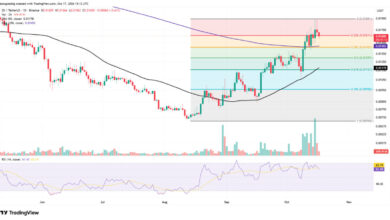
STRK trades at $0.0545 on the 4-hour Binance chart, about 57% below the October 11 high of $0.1265, after unwinding most of a 231% rally from $0.0382. The steepest leg of that move started on October 8, the day Ben-Sasson floated the L1 idea. On October 21 buyers pushed price above $0.066 on the heaviest volume since mid-month, but the move stalled at the upper channel line. Price then closed below the 200 EMA at $0.0588 and the 0.786 Fibonacci level at $0.0571, so that band now acts as resistance.
Resistance
$0.0588
200 EMA, the level to reclaim
Price now
$0.0545
Inside a descending channel
Support
$0.0482
0.886 Fibonacci and channel floor
The $0.0482 level matches the October 7 and 8 lows, and the lower channel line is converging on it. A 4-hour close below would leave little support until $0.044. The RSI reads 38.35, below the neutral 50 mark but not oversold, and it made a higher low while price retested $0.0537. Sellers are losing some force, though the trend has not turned. A close back above $0.0588 would be the first sign of a recovery.
November whitepaper becomes the next test for the L1 case
The draft whitepaper should show how consensus would work, what replaces Ethereum for data availability and how many validators the network would need. Ethereum’s timetable is the other variable. The Ethereum Foundation has said that reaching full post-quantum readiness would require an average of 7.2 months per fork, a faster cadence than most of Ethereum’s past upgrades, with even the next upgrade, Glamsterdam, still waiting for a mainnet date. Each delayed upgrade strengthens StarkWare’s argument, while a faster Ethereum schedule would weaken the main reason to leave.