ZRO Price Sinks Toward $1 Despite Zero Staking Launch

- The ZRO price extended its slide after a brief rally on the staking announcement faded.
- LayerZero opened ZRO staking a week before the Zero mainnet launch.
- Staked tokens stay locked until the end of March with no early exit.
- The daily chart is still in a downtrend, and the price is testing the bottom of its channel.
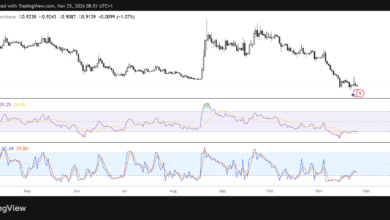
LayerZero’s ZRO fell to about $1.04 on Tuesday, November 24. It lost more than 9% on the daily candle and briefly touched $1.0048, after a rally sparked by the opening of staking for the upcoming Zero blockchain reversed within a day. The token has now given back roughly 58% since its October peak of $2.4809. The drop puts the $1 level in play less than a week before Zero’s mainnet goes live on November 30.
A Staking Rally That Lasted Less Than a Day
LayerZero announced on November 23 that staking was open, that rewards start accruing at the mainnet launch, and that every staked token unlocks on March 31, 2027. The LayerZero Foundation said it would stake 100 million ZRO, a tenth of the original one-billion supply, on the same terms as other participants.
Zero staking is now open. Rewards begin accruing Nov 30. All stake unlocks March 31, 2027.
The LayerZero Foundation will stake 100M ZRO on the same terms as other stakers. Pre-genesis stake will produce Zero's first blocks at mainnet launch, Nov 30.https://t.co/n1W4lOCYEh
— LayerZero (@LayerZero_Core) November 23, 2026
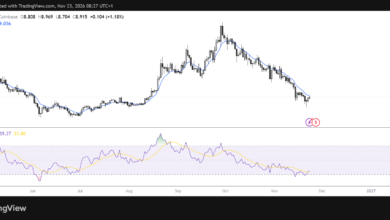
ZRO traded close to $1.30 on Coinbase during the November 23 session. Sellers absorbed the move, and the daily candle closed with a long upper wick, which shows buyers could not hold the higher prices. CoinMarketCap, which averages prices across exchanges, shows a 24-hour loss above 21%. Its rolling window starts from yesterday’s higher prices near $1.28, while the Coinbase daily candle only counts from midnight UTC. Over seven days ZRO is down almost 31%, which leaves its market capitalization near $414 million.
ZRO Price Tests the Floor of Its Downtrend

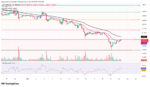
Since mid-October, the ZRO price has traded inside a descending channel, a pair of falling parallel lines that connect a run of lower highs and lower lows. Tuesday’s session took the price through the 0.786 Fibonacci retracement at $1.0866 and down to the channel’s lower line. A daily close below that line would mean the selling is now faster than the trend’s own pace, and that kind of move tends to attract more sellers who trade on momentum.
The 20-day and 50-day exponential moving averages, which track the average closing price over roughly the past month and the past ten weeks, sit at $1.3808 and $1.5136. ZRO trades about 24% below the shorter one, so most buyers from the past month are holding losses and could sell into any rebound toward that zone. The 14-day RSI has dropped to 27.69 intraday, its first dip below 30 since at least late July. That means the recent decline has been unusually steep compared with the token’s own recent moves. Readings like this often come before a pause or a short bounce, but they do not confirm a bottom on their own.
The levels that matter now:
- Support at $1, then $0.9092 (0.886 Fibonacci), with the July low of $0.7070 about 32% below the current price
- Resistance at $1.0866, then the $1.38 area where the 20-day EMA meets the 0.618 Fibonacci level at $1.3846
Four Months Locked for About 1% in Rewards
Zero’s monetary policy creates 10 million new ZRO a year, an inflation target equal to 1% of the original supply. Validators keep a 10% commission until March 31, which leaves about 9 million ZRO a year for stakers. Those rewards compound automatically after each epoch, the fixed period in which the network settles payouts. The reward pool is fixed, so each holder’s yield shrinks as more tokens are staked.
| Total ZRO staked | Share of supply | Est. annual yield |
|---|---|---|
| 100M (Foundation only) | 10% | 9.0% |
| 200M | 20% | 4.5% |
| 300M | 30% | 3.0% |
| 500M | 50% | 1.8% |
Simple estimates based on 9M ZRO in yearly staker rewards, before compounding.
At 30% participation, someone who stakes before genesis would earn about 1% of their stake by the March 31 unlock, because rewards run for only four months. During that time the tokens cannot be withdrawn, and because no liquid staking token is issued, holders get nothing they could trade or post as collateral in the meantime. Deposits are spread evenly across the genesis validators, and holders cannot pick their own. After the unlock, withdrawals face a cooldown of up to seven days. ZRO lost a fifth of its value in a single day, and a reward this small does little to make up for being unable to sell, which probably explains why the announcement did not bring lasting demand.
Why the Foundation’s 100M Stake Adds No New Demand
The Foundation’s stake was worth about $112 million at the $1.12 price quoted on the day of the announcement, and it is closer to $104 million at Tuesday’s level. These are tokens the Foundation already holds, so the commitment brings no fresh money into the market. According to LayerZero’s own token breakdown, the Foundation started with 383 million ZRO, and 250 million of those unlocked at the token’s launch. The remaining 183 million, including 50 million bought back from strategic partners in September 2025, were locked again until Zero’s mainnet.
The stake therefore keeps a large block of Foundation tokens off the market until March 31, when they could otherwise have become transferable at mainnet. The Foundation plans to deposit the full amount in two 50 million ZRO tranches. Early reports put about 50.65 million on-chain so far, and the full 100 million has not yet been confirmed. Tokens staked before genesis are burned on the chain where they sit now and reminted on Zero. That step moves supply to the new network without changing the total, so it is a migration and not a reduction in supply.
March 31 Becomes One Large Unlock Date
Every pre-genesis stake, the Foundation’s included, becomes withdrawable on the same day, and deposits added later do not move that date. That puts a lot of potential supply into one window at the end of March, on top of the 12.7 million ZRO monthly strategic partner unlock LayerZero disclosed in February. LayerZero is counting on revenue to offset that supply, with plans to send fees from trading, payments, computation and other activity on Zero into ZRO buybacks and burns. A large share of those fees is expected to come from ATLAS, a built-in market engine that handles order matching, clearing, settlement and risk management.
How much supply those buybacks can remove depends on real network usage, and none exists yet at mainnet scale. LayerZero has named DTCC, Intercontinental Exchange, Citadel Securities, Tether and Google Cloud as launch partners for Zero. Partnership status alone does not mean any of them will move production operations to Zero right away.
The first concrete test comes on November 30, when the pre-genesis stake produces Zero’s first blocks. LayerZero advertises up to 2 million transactions per second per zone and fees around $0.0000001 per transaction. Those figures describe the design limits of the architecture and have not yet been measured under sustained mainnet load. Zero aims to reach them by separating execution from verification: validators check zero-knowledge proofs, short cryptographic records showing that a computation was done correctly, and do not re-run every transaction themselves. Transaction counts and fee revenue in December will be the first hard data on whether the buyback model can create real demand for ZRO.